
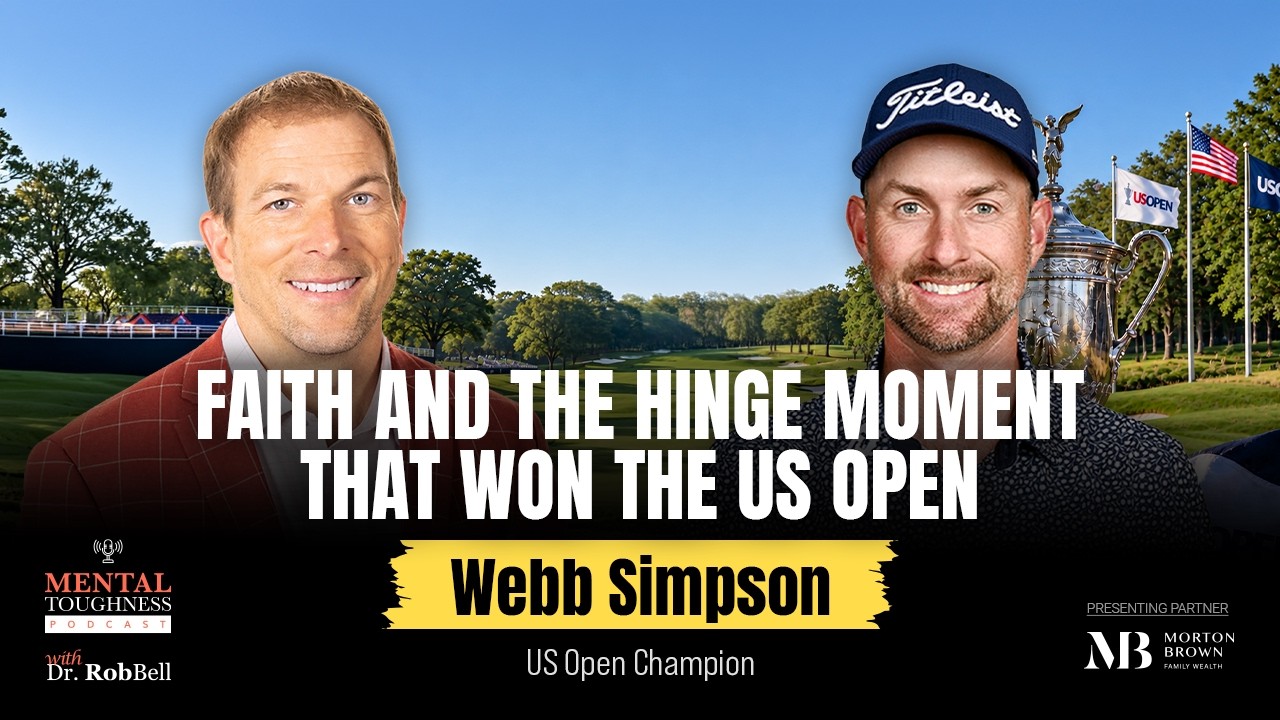
A major championship can turn on a decision that looks small from the outside. For Webb Simpson, the 2012 U.S. Open at Olympic Club came down, in part, to a quiet conversation with his caddie on the eighth tee.
Webb was between a five-iron and a six-iron. Paul Tesori had spent the morning noticing something unusual about that hole, and what he learned changed the club in Webb’s hands.
That hinge moment that won the U.S. open tells us a lot about the Webb Simpson. It was not simply a story of one great shot.
It was a story of preparation, trust, commitment, and a player who had learned to think beyond the result of any single week.
Those same themes run through Webb’s faith, his relationship with coaches and caddies, his difficult stretches on Tour, and his return to winning at the 2018 Players Championship.
Key Takeaways
- Paul Tesori’s observation and five-iron recommendation which was The Hinge Moment That Won The U.S. Open
- Webb’s long-term career mindset helps him keep one tournament from carrying too much pressure.
- Real confidence grows from sound fundamentals, visible progress, and committed decisions.
- Faith, family, and trusted relationships shape how Webb approaches both success and setbacks.
Faith Built Through Friendship and Golf
Webb’s friendship with William Kane started when they were kids, spending a summer playing golf every day.
They dreamed that if Webb made the PGA Tour, William would caddie for him. When Webb earned his Tour card in 2008, that childhood plan became real.
By then, William’s faith had become an important part of his life. Webb had become a Christian during his senior year of college, and William helped him grow during those first years as a professional. Their regular conversations about what they were learning in the Bible continued even after their working relationship on the course changed.
Ben Crane, who had also mentored them, became part of those conversations. Together, the three saw an opportunity to talk about golf and the gospel in a way that felt natural. That grew into the Bible Caddie Podcast.
What especially excites Webb is its reach beyond the podcast: more than 215 featured groups, as he described them, have used its material for Bible studies in clubs, workplaces, and homes around the world. The material gives group leaders a starting point while still leaving them responsible for becoming familiar with what they share.
Webb sees that work as an extension of personal faith, not a substitute for it.
- ⛳️ 2:42 The Origin of the Bible Caddie Podcast and a Friendship Built Through Golf and Faith
- ⛳️ 7:37 How Studying the Bible Shapes the Mental Approach to Life and Competition
- ⛳️ 11:39 Titus 3:3–7: A Favorite Bible Passage About Grace, Mercy, and Faith
- ⛳️ 14:21 How Fatherhood Deepens the Understanding of God’s Love
- ⛳️ 16:54 Living a Life That Others Are Watching
- ⛳️ 19:29 The Caddie Relationship That Helped Build Mental Toughness and Belief
- ⛳️ 23:46 Returning to a Long-Term Mindset Instead of Chasing Short-Term Results
- ⛳️ 25:12 Why Belief, Fundamentals, and Mental Toughness Have to Work Together
- ⛳️ 28:13 The Impact of Wake Forest Coach Jerry Haas On and Off the Golf Course
- ⛳️ 30:40 “Pleased, But Never Satisfied”: The Drive to Keep Getting Better
- ⛳️ 33:25 The HINGE MOMENT that won the U.S. Open & The Question That Changed the Mindset.
- ⛳️ 35:00 Winning the U.S. Open by Focusing on the Process, Not the Leaderboard
- ⛳️ 39:33 Total Commitment: Why a Decision Means Eliminating Every Other Option
- ⛳️ 41:41 HINGE MOMENT: The Struggles That Made the 2018 PLAYERS Championship Victory So Meaningful
- ⛳️ 46:36 Remembering the Feeling of Walking to the 17th Hole at TPC Sawgrass
- ⛳️ 48:37 Why Ryder Cups and Presidents Cups Create a Different Kind of Pressure
- ⛳️ 52:28 Fight, Resolve, and the Spirit of the U.S. Ryder Cup Team
- ⛳️ 57:25 What Makes Scottie Scheffler a Once-in-a-Generation Golfer
What You Feed Your Mind Shapes What You Believe
Webb’s father taught him that the people we spend time around shape who we become. Webb applies the same principle to the mind: what we take in regularly begins to influence what we believe. Feelings matter, but they can also be fleeting or lead us somewhere unhealthy.
For him, Scripture provides a truth to return to when his thoughts feel crowded.
He gave a personal example. On a morning when he felt burdened, Psalm 94:19 spoke directly to the cares on his heart and the comfort he found in God. The circumstances had not vanished, but the passage helped him approach them differently.
One of Webb’s favorite passages, Titus 3:3-7, explains why the gospel matters so much to him. He values its honesty about humananity and its account of God’s mercy through Jesus Christ. In Webb’s words and life, faith is not a claim that everything is easy. It is a foundation for facing what is true.
Fatherhood has deepened that understanding. Webb knows how imperfect his own patience can be with his five children, yet his love for them does not disappear when they make mistakes. That gives him a small, encouraging glimpse of what he believes about God’s love. He also knows his children notice more than he sometimes realizes. The way he and his wife live, and what they choose to care about, teaches even when they are not trying to teach.
The Caddie Who Helped Webb Play the Long Game
The Webb Simpson U.S. Open story makes more sense when you understand his relationship with Paul Tesori.
Paul helped Webb sharpen his course management, practice habits, and fundamentals. In an era when golf technology can provide endless information, Paul kept bringing him back to essentials such as grip, setup, and alignment.
He also helped Webb believe he could win. A caddie spends enough time with a player to see the good days, the impatient days, and everything between. Paul became a friend and mentor as well as the person helping Webb make decisions under pressure.
Early in their partnership, Paul gave Webb a perspective that stuck: they were not building toward one tournament or even one season. They were trying to build a career that would last more than 15 years. For a young player, that changed the meaning of a disappointing week. A poor finish still hurt, but it did not have to become a verdict on the entire project.
That long-term mindset matters just as much during a slump. Webb described how easy it is, after years of poor play, to feel that the next tournament has to be the one that fixes everything. Paul’s response was to prepare well, compete one day at a time, and stop loading one event with more pressure than it deserved.
Belief, though, cannot be faked. Webb has been candid about stretches when he did not believe his swing or physical game was improving. Telling himself to be confident was not enough. He needed sound fundamentals and visible progress alongside the mental work. That connection between preparation and belief is central to building genuine confidence.
Small Goals, Strong Fundamentals, and a Bigger Purpose
Webb still carries lessons from Wake Forest coach Jerry Haas. Jerry taught him to create small competitions within a round. If Webb was one over par after three holes, he could focus on getting a stroke back over the next three or six. The whole round did not have to feel like one enormous problem.
Jerry also gave him a weekend goal: after making a cut, try to play the final two rounds better than the first two. Webb recalled using that idea at Greensboro, where it gave him a clear target and helped him move up the leaderboard. A coach’s voice can stay with a player for years, particularly when the advice makes the next task feel manageable.
That does not mean Webb has stopped wanting more from his game.
At 16, he shot a 58 at his home club, yet he can still remember a missed six-footer and a par on a reachable par five. Golf always offers another shot that could have been better. Webb believes there is a healthy desire to improve, but he does not want championships to carry the weight of his entire identity. For him, working hard is a way to make the most of what he has been given, not a way to find ultimate satisfaction in a score.
Webb Simpson and The Hinge moment that won The U.S. Open
On the Tuesday before the 2012 U.S. Open, Paul asked Webb whether he would accept second place if it were offered to him immediately.
Webb said yes.
He had not yet contended in a major and believed that experience would help him grow. Paul may have expected a more defiant answer, but Webb’s response reflected the career-long perspective they had built together. By Sunday night, of course, Paul was glad they had not settled for second.
Webb began the final round four shots back. Before he went out, Paul suggested avoiding looking at the leaderboard on the front nine.
The opening six holes at Olympic Club were especially demanding, and Paul did not want an early over-par stretch to tempt Webb into forcing birdies. Webb was two over through five, but he stayed with the round in front of him. Birdies at six, seven, eight, and ten changed the shape of the championship.
The eighth is the shot Webb still keeps a photograph of in his office. That morning, Paul had observed several groups playing the par three and noticed that nearly everyone finished well short, despite a back-left hole location. He did not see enough wind to explain it. Hours later, Webb stood on the tee between a five-iron and a six-iron. His first thought was to hit a strong six. Paul reminded him what he had seen and recommended the five.
Webb aimed for the middle of the green. He pulled the shot slightly toward the hole, and the ball barely carried the front-left bunker. It finished roughly 30 feet short of the cup. He made the birdie putt.
After winning the Webb Simpson U.S. Open title, he kept returning to that decision. Based on how the five-iron flew, he believes the six would have come up short and might have cost him a stroke. Paul’s work earlier in the day had given them information they needed at precisely the right moment. That was the hinge moment that won The U.S. open.
That is why the photograph means more to Webb than a picture of a good swing. It reminds him what a prepared caddie can contribute when a championship is on the line.
Pick a Target, Then Commit to It
The eighth-hole choice was not a license to aim recklessly. Webb was aiming for the middle of the green, even though the shot moved left. His larger principle is to make a decision and stop quietly negotiating with it once he stands over the ball.
He learned this most clearly through putting. During a poor stretch, he would sometimes agree on a read with Paul, get over the putt, and decide it needed more break. Too often, that last-second adjustment was wrong. Paul encouraged him to stand over the ball during his preparation and feel the putt before committing. It helped Webb eliminate the second-guessing that had crept into his stroke.
The same idea applies from the tee.
On the 18th at Quail Hollow, with a creek to the left, Webb may choose the right-center of the fairway as his target. He does not aim there while secretly trying to pull the ball toward the middle. He commits to right-center. A fully committed swing can still produce a bad result, but repeatedly steering the ball away from trouble is no answer. It is a distinction worth remembering whenever second-guessing threatens a golf shot.
Why the 2018 Players Win Meant So Much
The Webb Simpson U.S. Open victory was a career-defining major. Webb calls his 2018 Players Championship his most special win for a different reason: everything he had been through before it.
After changing from a belly putter ahead of its ban, he struggled with anxiety over his putting. His ball-striking could be good while his putting remained near the bottom of the Tour rankings. He began to wonder whether he could win again. Then, in November 2017, his father died after living with Lewy body dementia. Webb arrived at the 2018 Players without a victory since 2013, carrying both a long professional drought and a personal loss.
There had been signs of progress.
Tim Clark had encouraged him to try a claw putting grip at the 2017 Players, and Webb began rebuilding trust in his putting. In 2018, he opened with a 66. On Friday, he was 11 under through 16 holes and felt a rare combination of calm, enjoyment, and sharp focus amid the challenges of Sawgrass. Saturday brought wind and tougher scoring, making his 68 especially satisfying to Paul.
Webb took a seven-shot lead into Sunday, but Sawgrass gives a lead no guarantees. After bogeys at eight and ten, Paul could tell Webb needed a reset. Walking toward the 11th, he pointed out the opportunities still ahead: reachable par fives at 11 and 16, plus a wedge opportunity at 12. Webb birdied 11 and 16. When his ball found the green at the 17th, he felt the win was within reach, though he still had golf to play.
The celebration held more than relief.
Paul Tesori had grown up playing Sawgrass. Webb’s wife was there. It was Mother’s Day, and his father’s death was still recent. The four-and-a-half-year wait made that victory feel different from any other.
Team Pressure and the Example of Scottie Scheffler
Individual golf asks a player to manage his own score. Ryder Cups and Presidents Cups add a partner, a team, and a country to the equation. Webb remembers his first Presidents Cup in Australia in 2011 as a new kind of excitement and responsibility. Bubba Watson was a comfortable first partner, and they won their first three matches together.
As an assistant captain, Webb approaches team events differently. He has valued learning from experienced captains and helping put great players in the best position to succeed. He also sees how misleading expectations on paper can be: at one Presidents Cup, he recalled Sam Burns and Scottie Scheffler playing superb best-ball golf across two matches yet earning only half a point. Team competition can lift everyone’s level, including the opposition’s.
That is why Webb puts so much stock in a team’s response to adversity. After difficult opening days against Europe at Bethpage, he was proud of the American team’s fight in Sunday singles, even though the comeback fell short. For him, the lesson is not to manufacture chemistry or force a result. It is to recognize the ability and closeness already there, then compete with it.
Webb sees a related model in Scottie Scheffler.
He admires Scottie’s fundamentals, decision-making, faith, family priorities, and fierce competitiveness. He is still learning from Scottie’s choices on the course. One part of Scottie’s approach especially resonates: do the preparation early in the week, then compete knowing the work has been done.
From the five-iron at Olympic Club to a difficult Sunday at Sawgrass, Webb’s best moments did not come from pretending pressure was absent. They came from doing the work, listening to people he trusted, choosing a target, and committing to the next shot.

Dr. Rob Bell is a Sport Psychology Coach. DRB & associates coach executives and professional athletes. Some clients have included three different winners on the PGA Tour, Indy Eleven, University of Notre Dame, Marriott, and Walgreens.
- Check Out All The Books
- Keynote Speaking On Mental Toughness
- Mental Toughness Podcast as we interview expert athletes and coaches about Mental Strength and their Hinge Moment.
- New Blog Posts are published weekly.
- Follow on Twitter @drrobbell
- Follow on Instagram @drrobbell

Leave a Reply