Coach Kim Lewellen has built a championship career in college golf, including leading Wake Forest women’s golf to its first NCAA National Championship in 2023. But one of the most powerful lessons from this Mental Toughness Podcast conversation has nothing to do with a swing, a scorecard, or a trophy.
Coach Kim Lewellen started leaving 10 minutes early.
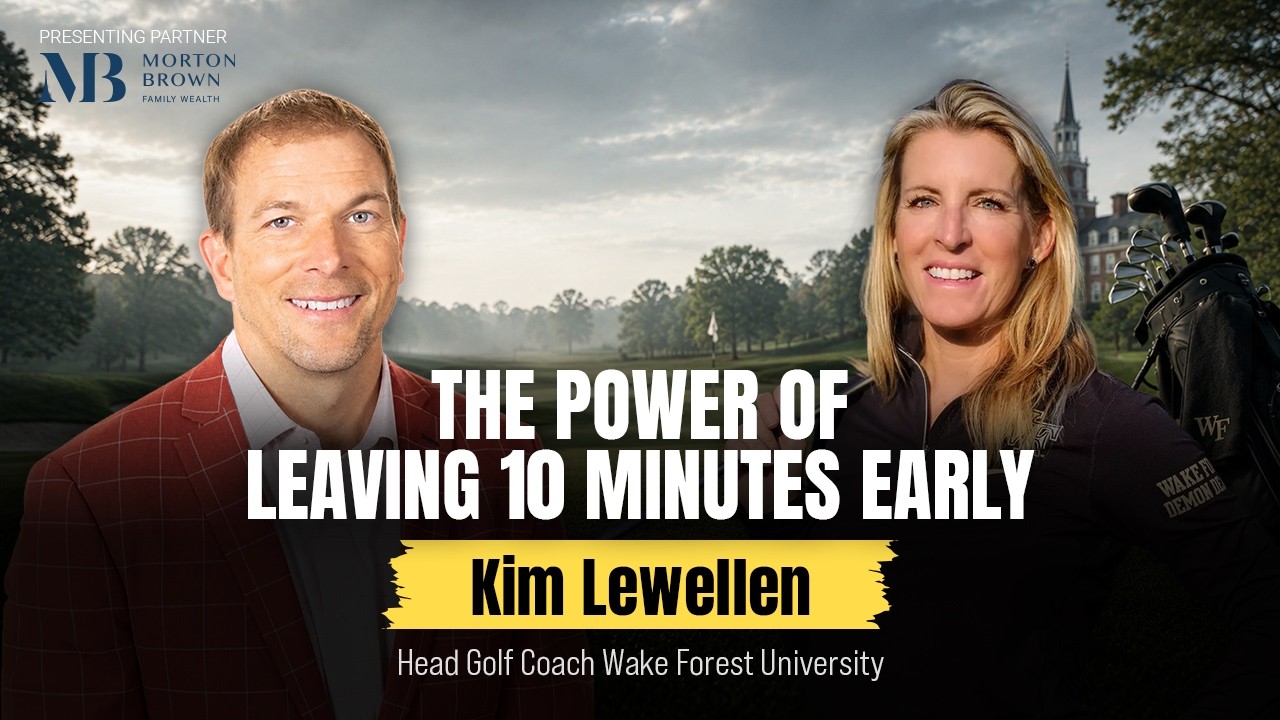
That small habit gave her room to breathe, room to be present, and room to stop when somebody needed her. It is a simple idea, but it gets right to the heart of mental toughness: the habits we build end up building us.
Key Takeaways
- Leaving 10 minutes early creates space to be present and help people when they need you.
- Do not overvalue mistakes: learn from the last shot, then commit to the next one.
- Build your armor during good times by strengthening routines, preparation, confidence, and relationships.
- Train for future opportunities without testing your worth through every result today.
Leave 10 Minutes Early So You Have Time to Stop
The question is simple: if you saw somebody who needed help, would you stop?
Most of us would say yes. But studies on helping behavior have shown that when people are rushed or late, they are far less likely to stop. It is not necessarily because they do not care. They simply believe they do not have time.
The Coach Kim Lewellen Podcast shows how she took that lesson seriously. She began leaving for every appointment 10 minutes earlier, and even started waking up 10 minutes earlier. The reason was not merely to avoid being late. It was to make sure she had the time and margin to help, listen, and have a real conversation if she was needed.
The change became real one day while she was heading to work in her golf cart. Normally, she might have honked, waved at a friend walking by, and kept moving. Instead, because she was not rushed, she stopped.
Her friend had recently lost his wife. He needed to talk about her, share memories, and be heard. That conversation would not have happened if Coach Kim Lewellen had been running late. Ten minutes created enough space for one person to become the most important person in that moment.
That is the challenge. Do not make your schedule so tight that there is no room for people. Build margin for conversations, for kindness, and for the moments that cannot be planned.
That same approach showed up at a junior golf camp. By arriving early enough to have the stations already set, Coach Kim Lewellen had time to talk with each young golfer instead of rushing past them to prepare. Being early was not about getting more done. It was about having enough time for everybody.
Relationships Are the Real Foundation
The Coach Kim Lewellen Podcast revealed that she lives close enough to Wake Forest’s golf facility to take a golf cart to work. Her players may stop by to say hello, see her pets, or walk through her gate on the way to Old Town Club. That accessibility matters.
Relationships are one of the reasons she coaches. The everyday touch points create trust, and trust means players know where to go when something serious happens. Great coaching is not only instruction. It is being available for the fun moments and the difficult moments.
This is also why the message of No One Gets There Alone matters. Nobody reaches a meaningful place by themselves.
Every person around us is someone we can help, someone who can help us, or both.
A Hinge Moment Can Start With 15 Uncomfortable Seconds
Before becoming the accomplished coach she is today, Coach Kim Lewellen had stepped away from the golf business while raising her young children. Living in Charleston, she was ready to return to golf instruction but was not getting any traction.
Then she and her husband attended a tennis match. Her husband spotted Les Robinson, the athletic director at The Citadel, and encouraged her to introduce herself.
She knew it might be an uncomfortable 10 or 15 seconds. Still, she walked over, introduced herself, and told him she wanted to get back into golf and would love a coaching opportunity.
That conversation led first to a marketing job offer, which she declined because golf was where her passion was. A week later, Robinson called again with an opening to coach both men’s and women’s golf at The Citadel.
That one hinge moment changed everything. The relationship later helped Coach Kim Lewellen move to East Carolina, then Virginia, and eventually Wake Forest. A single introduction opened a coaching path that shaped the rest of her life.
The lesson is not that every tennis match changes your life. It is that opportunities often require us to show up and be willing to put ourselves out there. Sometimes the hard part is just those first 15 seconds.
Do Not Overvalue a Bad Shot
One bad shot does not define a round, just as one bad point does not define a tennis match. Yet human nature tends to assign too much weight to failures.
Coach Kim Lewellen teaches her players to treat a missed shot as information, not an identity. A poor result can be investigated:
- Was it a mechanical issue?
- Did the lie create a problem?
- Was the wind misread?
- Was the player mentally out of position?
- Did the routine break down?
A missed shot can be helpful if it leads to better information and a better decision. The goal is not to deny what happened. The goal is to learn from it without turning it into a catastrophe.
That distinction became critical after Wake Forest lost to Virginia in the ACC semifinal in 2023. The team had tremendous talent, but high expectations had made every missed shot, bad lie, wind shift, and unfavorable break feel bigger than it really was.
After that loss, the team reset. The players stopped being reactionary and became more solution focused. If a shot was not what they wanted, they used their post-shot routine, left the result behind, and returned to the process of the next shot.
At regionals, one player made a seven on a par five. It was a rare score for a world-class player, but her reaction showed the difference in mindset. She did not carry it around. She threw it away and continued competing. That ability to move on helped set the stage for a national championship.
This is the same distinction between reacting and responding explored in five ways to respond to adversity. Slow down, regain composure, and choose the next right response.
Debrief Often, but Stay in the Right Moment
Coach Kim Lewellen and her staff use debriefing constantly. A debrief may happen after a tournament, a practice round, a regular practice, or when a player simply walks into the office wanting to talk.
The purpose is to understand what is really happening. Is the issue equipment? Is it process, routine, strategy, confidence, or physical preparation? The quality of the answer depends on the quality of the conversation.
Sometimes a player wants to debrief while walking down the fairway during a difficult round. That may not always be ideal, especially in a championship situation. But during a regular season event, Coach Kim Lewellen is willing to hear the player out if that is when the best information is available.
The better a coach knows the athlete, the faster and more useful those debriefs become. Know the person, understand their language, and take a genuine interest in them. That is what turns feedback into something actionable and that’s how mental toughness is built.
Stay Present When the Stakes Are Highest
Coach Kim Lewellen had experienced close calls before the 2023 national championship. At Virginia, an incorrect scorecard cost her team an NCAA title in the stroke-play era. The experience reinforced the importance of attention to detail.
In Wake Forest’s 2019 runner-up finish, she also identified a moment where she wished she had been more involved with a player whose shot pattern changed under pressure.
Those experiences mattered in 2023. During the national championship match, much of the attention was focused on a match behind her that appeared likely to decide the title. But Coach Kim Lewellen stayed with Mimi Rhodes on the 17th hole, focusing completely on her player and her putt for birdie.
There were no cameras around them. There was no crowd gathering at their match. Still, she stayed put because that was the assignment in front of her.
Then the cheers erupted from behind them. Wake Forest had won the national championship.
At the biggest stage, time can feel like it speeds up and thoughts can start racing. The answer is to slow down internally and become fully present. Do not let the noise, the pressure, or the possible outcome pull you away from the moment that needs your attention.
Winning Feels Better Than Having Won
The celebration of winning is real, and it should be enjoyed. But winning can also create a new set of expectations. After a player wins one event, she may immediately believe she must win the conference championship, then the NCAA championship, then something else.
Coach Kim Lewellen sees how quickly success can become pressure when athletes begin chasing trophies instead of enjoying the work.
Enjoy the win. Celebrate what was earned. Then get back to the process of becoming one percent better, competing with teammates, and continuing to learn your craft. Collecting accomplishments is not the same thing as loving the work it takes to become great.
Build Your Armor When Things Are Going Well
One of the most practical phrases Coach Kim Lewellen uses is this: build your armor when things are going well because there will be a time when they are not.
When a golfer is healthy, confident, and playing well, that is the time to strengthen the foundation. Get stronger in the gym. Improve technical work. Make sure equipment is right. Establish routines. Develop mental strategies that are actually working.
Do that work before the injury, the bad round, or the confidence dip comes. Then, when adversity arrives, there is something solid to fall back on.
The same goes for life. We should not wait for a hard season to build the habits, relationships, faith, and routines that carry us through hard seasons.
Two Rules: Be Kind and Work Hard
Coach Kim Lewellen has two rules for her program: be kind and work hard.
People can be late once in a while. They can forget a competition shirt. Those things can be fixed. But an unkind word toward a teammate requires a conversation.
A team is a powerful training ground because people are together constantly. There will be crowded kitchens, hard days, disagreements, and moments where patience is tested. That is exactly why kindness matters.
Kindness also includes the way athletes talk to themselves. It is easy to greet a teammate with encouragement. The harder assignment may be offering that same patience and respect inward when the game is not going well.
What Great Players Do Differently
Coach Kim Lewellen sees two traits repeatedly in elite performers: persistence and a willingness to treat performance as a puzzle.
Talented players still fail. They have poor tournaments. They miss shots. But the best ones return to the work. They do it again. They stay persistent long enough for their talent, preparation, and work ethic to show up.
They also avoid the spiral of, “Here I go again.” Instead, they ask, “What piece of this puzzle do I need to solve?” A putting issue, chipping issue, technical issue, or confidence issue becomes a problem to work through, not proof that they are broken.
Confidence is part of that equation. Doubt will always show up, but it cannot be allowed to take up permanent residence. Let the thought play through. If it contains useful information, use it. If it does not, let it leave.
Real confidence comes from within, not from rankings, recent scores, or outside validation.
Give Athletes Ownership of Their Development
Coach Kim Lewellen and her assistant coach, Ryan, do not treat practice like a mandatory block where every player follows the same script from 2:00 to 5:00.
Instead, the coaching staff serves as a resource. They use statistics, provide drills, offer an extra set of eyes, and help players identify what needs attention. When needed, they refer players to equipment experts, mental performance specialists, strength coaches, physical therapists, or other professionals.
The athletes take ownership of their routines and practice plans. That matters because college eventually ends. Players who turn professional must know how to organize their own development without someone telling them what to do every hour of the day.
Habits also matter outside the golf course. A player may not initially love working out, but a consistent Monday, Wednesday, Friday routine can become a durable habit. Eventually, the routine becomes part of who they are.
Greens in regulation and proximity to the hole are important performance indicators. But Coach Kim Lewellen also believes one of the strongest predictors of success is competing often. The more a player competes, the more a major event starts to feel like another event.
That was true for Carolina Chacarra, who stayed amateur after graduating so she could accept more starts and compete every week before qualifying school. By the time she reached Q-School, she had her swing thoughts, playing thoughts, and mental thoughts ready. She was prepared because competing had become normal.
Train Yourself, Do Not Test Yourself
As seniors approach graduation and consider turning professional, many start asking the same question: “Am I good enough?” Every shot becomes evidence for or against them.
That is a dangerous way to live. A poor practice session on Wednesday can suddenly become a prediction about Saturday’s tournament. One rough round becomes a judgment about an entire career.
The better reminder is this: it is not here yet.
If the decision about turning professional is a month away, make that decision a month from now. Do not time travel. Do not test yourself every day by asking whether you would make it if today were the day. Train yourself instead.
Ask when the tournament actually starts. If the tee time is Thursday at 1:40, that is when you need to be ready. Until then, breathe, relax, train, and solve the problem in front of you.
The Just One More Mindset
There is a difference between endlessly chasing one more golf ball because of anxiety and intentionally doing one more rep because of commitment.
Coach Kim Lewellen sees value in the latter. One more rep. One more phone call. One more encouraging conversation. One more prayer. One more practice test after getting a perfect score.
That final repetition can move the needle.
Steve Young reportedly reviewed 300 plays before the Super Bowl, and after he had completed them, coach Mike Shanahan asked him to go through them one more time.
Coach Kim Lewellen used the same idea with her son before his flight exam. Do the practice test until you get 100. Then do it again. Get two perfect scores. Then get three. That extra preparation makes a response more automatic when pressure introduces doubt.
It is not about grinding yourself into the ground. It is about doing the small extra thing with intention. That is how mental toughness becomes a habit.
Lead With Love
Coach Kim Lewellen understands that athletes want to be coached hard. They want accountability, standards, and honest feedback. But all of that works best when love is underneath it.
Players need to know they are valued as people, not just as scores, results, or potential recruits. Golf is something they do. It is not all that they are.
When athletes know they are cared for, they can receive coaching more fully. They can take risks, debrief honestly, learn from mistakes, and keep going through adversity. That is how a coach helps bring out the magic in a player.
Leave 10 minutes early. Be kind. Work hard. Stay in the process. Do one more. Those are not secrets. They are habits, and the habits you build will build you right back.

Dr. Rob Bell is a Sport Psychology Coach. DRB & associates coach executives and professional athletes. Some clients have included three different winners on the PGA Tour, Indy Eleven, University of Notre Dame, Marriott, and Walgreens.
- Check Out All The Books
- Keynote Speaking On Mental Toughness
- Mental Toughness Podcast as we interview expert athletes and coaches about Mental Strength and their Hinge Moment.
- New Blog Posts are published weekly.
- Follow on Twitter @drrobbell
- Follow on Instagram @drrobbell