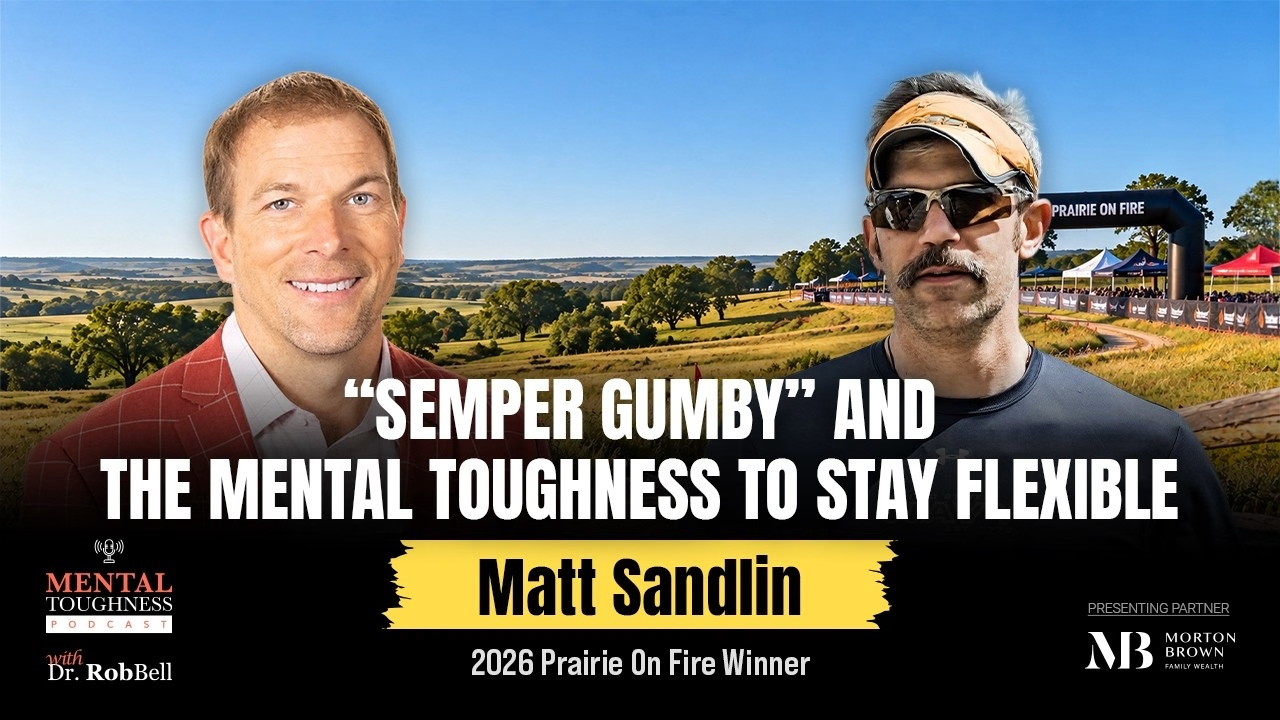
Mental toughness is about changing the plan, taking care of a problem, and refusing to let one difficult moment define the entire experience.
That is the heart of Semper Gumby, the always-flexible mindset that helped Matt Sandlin become the last runner standing at the 2026 Prairie on Fire Backyard Ultra. He completed 43 yards, roughly 179 miles, and set the course record.
I ran 100 miles in this race..
But the mileage is only part of the story. His hinge moment grew out of Navy boot camp, an overheated folding chair in the Arizona desert, years of training in the dark, a deep Christian faith, and a community that showed up when he expected to be alone.
The lesson connects all of those experiences: stay committed to the purpose while remaining flexible about the path.
Key Takeaways
- Mental toughness includes changing an ineffective plan rather than stubbornly following it.
- Small, immediate goals help runners stay engaged through difficult stretches.
- Night training helped Sandlin prepare for racing while protecting time with his family.
- Faith and community gave Sandlin support that did not depend on his finishing position.
Table of Contents
- The Hinge Moment That Changed His Life
- Going Longer Instead of Faster
- The Hot Chair That Changed His Running Career
- Training to Own the Night Without Losing Family Time
- Finding Perspective in the Quiet Miles
- Prairie on Fire: A Race That Requires Other People
- Faith That Did Not Depend on the Finish
- The Inner Voice and the Next Tree
- Running as Fellowship and an Expression of Faith
- Focus Only on the Light in Front
- Semper Gumby: A Plan Is Not a Promise
- A Champion’s Plaque Belongs to More Than One Person
- A Firm Foundation for an Uncertain Path
The Hinge Moment That Changed His Life
Before joining the Navy, Sandlin was running, but he was also struggling academically and making decisions that were not moving his life in a healthy direction. Enlisting brought both excitement and fear.
In 2006, while waiting to enter boot camp near Chicago, he accepted a pocket New Testament from Gideons handing them out outside the USO. At the time, taking it was almost an automatic gesture. During the first few weeks of training, it became something much more important.
Boot camp turned his world upside down. The stress, structure, and constant demands stripped away familiar distractions. Life became remarkably immediate. Sometimes the next meaningful objective was simply getting to the next meal.
In that environment, Scripture began to feel alive to him in a way it had not before. Reading gave him encouragement and perspective during the process of being broken down and rebuilt.
Sandlin describes that period as the crucible that changed his direction. Accountability, responsibility, and self-confidence began replacing the habits of his earlier life. Faith was not separate from that transformation. It was central to it.
His military path also required flexibility. He enlisted with the goal of becoming a rescue swimmer and took part in demanding early-morning preparation, including water training and pull-ups before the rest of boot camp was awake. A diagnosed heart condition eventually prevented him from flying, requiring a change of course.
The original plan changed. The willingness to work did not.
Going Longer Instead of Faster
Matt Sandlin never considered himself a particularly fast runner. He ran cross country in high school, then became curious about distances beyond a 5K, a half marathon, and eventually a marathon.
Early on, marathons sometimes served as an excuse to visit a new city. A trip to Nashville could become a race weekend, even without much structured preparation. Eventually, he recognized that his running deserved more attention. Better lifestyle habits and an actual training plan gave that ability room to develop.
While living near Joshua Tree on a Marine Corps base, he trained on stretches of desert that felt almost lunar. Hours could pass without another person in sight. Against that backdrop, ultrarunning seemed like a natural next step.
The stories of Dean Karnazes and Scott Jurek, along with the ideas associated with Born to Run, fed his curiosity. What would happen after the familiar marathon distance ended? What would that first step beyond 26.2 miles feel like?
In 2008, he entered the Calico Trail 50K and discovered that going farther at a slower pace suited him.
Trail running also offered freedom from the constant demands of the clock. Roots, rocks, and elevation required attention to the terrain rather than an obsession with pace. For Sandlin, trails provided a welcome contrast to daily life, which so often happens inside the straight lines and right angles of phones, computers, cars, and buildings.
Out there, the shapes were organic. The space helped him get his head right.
The Hot Chair That Changed His Running Career
After a planned 100K was canceled because of a forest fire, Sandlin jumped to the Javelina Jundred in Arizona. The terrain and altitude resembled his training environment, and the race had a reputation for being fast. That made it seem like a reasonable first attempt at 100 miles.
Reasonable, of course, is relative when the task is running 100 miles.
About 20 miles into the race, things started falling apart.
He was overheating, overexerted, and likely moving too quickly. At an aid station roughly five miles from the end of his second loop, he sat in an aluminum folding chair and decided to quit.
He could already justify it. Most people he knew had never run that far. A day of 25 or 30 miles could still count as a good day. When the vehicle collecting dropped runners arrived, he planned to ride back.
Then the chair started burning his thighs through his shorts.
The desert heat had made sitting still painfully uncomfortable. Sandlin experienced that moment as a spiritual nudge, one that confronted a larger pattern in his life: unfinished school, neglected relationships, and a tendency to leave when things became difficult.
He got up.
The immediate task was not finishing the remaining 70-plus miles. It was getting back to the next aid station. He shuffled, walked, and gave himself a chance to recover.
That five-mile stretch taught him something he could not have learned from a comfortable race: a low point can change with time, nutrition, self-care, and a willingness to stay engaged.
Feeling terrible did not automatically mean the race was over. The problem needed attention, not an instant surrender.
He eventually finished in roughly 26 to 27 hours. That first 100-mile belt buckle represented more than distance. It was evidence that something worthwhile could grow if he was willing to nurture it and the Mental Toughness to stay flexible.
Small Wins Make a Big Task Manageable
Sandlin did not climb out of that low point by staring at the whole distance. He narrowed the task to the next cactus, the next aid station, or the next hour.
Each completed objective gave him another small win. Those wins built momentum.
A lesson from boot camp helped organize his thinking: control the things within his responsibility. The weather and terrain were not his to command. His reaction, preparation, and next action were.
That distinction matters. Mental Toughness to stay flexible does not require favorable conditions. It requires a useful response to the conditions that actually exist.
Training to Own the Night Without Losing Family Time
Sandlin’s 1:00 a.m. and 3:00 a.m. runs can sound extreme until the purpose becomes clear. He wanted to pursue ultrarunning without sacrificing his presence as a husband and father.
With a full workweek and three children, disappearing for six hours on a Saturday would consume a large part of his family time. Starting a long run in the dark let him put in the miles before much of the household’s day began.
The habit developed gradually. While training in San Antonio for Rocky Raccoon, he told his running friend Jay that the next weekend’s run needed to begin at 3:00 a.m. Jay recognized that as a pretty rowdy start time.
Over time, though, 3:00 a.m. became normal. Then 1:00 a.m. did not feel like such a large leap. Going to bed early helped make those starts part of his routine. His wife, Rachel, once encountered him heading out around the same time she was heading to bed, a funny reminder of how differently their schedules could operate.
At least 90 percent of his training happened in darkness.
That schedule served a second purpose. In a 100-mile race, the hours between roughly 10:00 p.m. and 4:00 a.m. can become a major challenge. Sandlin intentionally practiced that difficult component rather than hoping it would be manageable on race day.
When fatigue or darkness became uncomfortable, he could draw on familiar experience. He had been there before. He had made it through and he built it through training his Mental Toughness to stay flexible.
Training made the night less unfamiliar while protecting the life he wanted outside running.
Finding Perspective in the Quiet Miles
There is a difference between feeling isolated and having useful time alone. Sandlin values the latter.
His early mornings often begin with coffee and Scripture. The run that follows gives him space to work through a difficult week, a workplace issue, or a conversation he needs to have.
Without the constant pull of a phone or another easy distraction, he can stay with an uncomfortable thought long enough to examine it. What might the other person’s perspective be? How might a particular response land? What is the actual issue beneath the emotional reaction?
Prayer helps him process those questions and approach the eventual conversation with a calmer heart.
The point is not to rehearse a better argument.
It is to take some of the sharpness out of the interaction so the discussion can focus on the problem rather than the offense.
The quiet miles also bring unexpected rewards: an unusual sunrise, animals behaving in ways he has never noticed, or a transition from darkness to dawn that feels entirely new.
He does not set out demanding those moments. They arrive as small gifts, and they help explain why he keeps coming back.
Prairie on Fire: A Race That Requires Other People
A backyard ultra has a simple structure and an unforgiving clock. At Prairie on Fire, runners complete a 4.167-mile loop, called a yard, beginning at the top of every hour.
Finishing quickly does not create an earlier start for the next loop. Every remaining runner must return to the starting grid for the next hourly departure. The format continues until one runner completes a final yard alone.
The standard backyard ultra rules explain why the final competitor alongside the winner is known as the assist. Another runner’s continued participation makes a longer performance possible. Once everyone else stops, the remaining athlete can complete only one additional yard.
That creates a distinctive relationship between competition and cooperation. The runners are trying to outlast one another, but they also need one another to keep the experience going.
At the 2026 event, my brief conversation with Sandlin during the first night changed my sense of who might win. Sandlin seemed to be in the right headspace. He was not fixated on proving a prediction correct. He wanted to contribute to something meaningful.
The Preparation That Removed Mental Exits
Sandlin had participated in Prairie on Fire twice before.
On his first attempt, he deliberately stopped after 25 yards to protect upcoming race plans, including a 100K and a return to Rocky Raccoon. It was a conscious limit, but he left wanting more.
The following year, he completed 29 yards. This time, unresolved practical responsibilities began occupying his mind. By Sunday morning, he felt homesick and convinced himself that he needed to return home to sort things out.
Rachel reassured him that everything was fine and asked whether dropping would leave him with regrets. At the time, he felt certain it would not. Later, he recognized that he had walked away without fully testing what remained.
For 2026, he changed the preparation. He cleared the calendar after the race and completed training he felt satisfied with. The logistical concerns that had previously offered an easy exit were addressed.
His prayer before the race was not a demand for victory. He wanted God to use him in something special, whatever that turned out to be.
He expected that a top-five finish might be possible, but placing was not the central concern. That shift helped him arrive loose, unburdened, and ready to participate fully.
Faith That Did Not Depend on the Finish
Sandlin’s peace came partly from accepting how little a runner can guarantee.
Months of training can end with one awkward step. A walnut underfoot, an ankle injury, a food that does not sit well, or an unexpected blister can change everything.
He uses a lighthearted reinterpretation of DNF, normally “did not finish,” as a reminder to avoid doing anything fatal. Beneath the humor is a serious point: runners still have families, jobs, and responsibilities after the event. Proving toughness does not erase those realities.
His faith gave him a foundation that did not depend on the result. If the race ended earlier than he hoped, he believed he would still be loved and forgiven. His relationship with God would remain intact.
The race could matter deeply without becoming the measure of his worth.
During the event, an exposed road section became especially meaningful. Wind and rain made it a taxing stretch, and other runners often walked there. Sandlin repeatedly felt free to keep running, moving in a way that felt natural rather than forced.
He does not describe hearing an audible command from God. He describes a sense of encouragement and affirmation that he understood as the Holy Spirit’s presence. By the second day, he looked forward to that part of the course.
The nighttime turnarounds brought another kind of joy. Heading back toward camp, the sky seemed to take on a different hue, with stars becoming more visible. He felt present in the experience rather than trapped inside a mileage calculation.
He was also grateful for everything that did not go wrong. The performance felt unusually smooth. For him, appreciating that required recognizing how many small things had to hold together.
The Inner Voice and the Next Tree
One of the hardest opponents in endurance sport is the negative voice that already knows a runner’s vulnerabilities.
I encountered that negative voice during a severe vomiting episode around mile 71 at Prairie on Fire. The easy message was familiar- PUKE & RALLY. the day had not worked out, so walking back and accepting the end would be fine.
Instead, I gave himself a more useful instruction. If I timed out, I would time out while making a full effort, not after mentally surrendering.
I reached the start-finish area with roughly a minute and a half remaining, grabbed three gels, and continued.
That moment did not deliver every race goal I had hoped for. But, It still became a meaningful win because he recognized the negative voice and answered it with deliberate action. That was my own mental toughness to stay flexible.
Sandlin knew that struggle well. Sometimes regaining composure takes two minutes. Sometimes a runner wrestles with a low point for six or eight hours.
The approach remains small and immediate:
- Reach the next tree or light pole.
- Address the problem that needs care.
- Recognize the completed effort as a win.
- Choose the next manageable objective.
Community also changes that internal battle. Sandlin knew friends from California, Naples, San Antonio, and Indianapolis were supporting and praying for him. Their encouragement did not create an obligation to perform for them. It reminded him that he was not facing the difficult moments alone.
Running as Fellowship and an Expression of Faith
Prairie on Fire’s relatively understated setting mattered to Sandlin. The organizers provided a place for the effort without needing to manufacture every emotion through loud music or spectacle.
That left room for something genuine to emerge: fellowship, shared struggle, and conversations that might never happen elsewhere.
I run without music, but played a faith-based playlist repeatedly through the night. The experience moved me to tears. At points, I placed a hand on another runner’s shoulder and offered a brief prayer.
One of those runners was Abe, whose knee had been hurting from the beginning. Another meaningful moment came around 100 miles, when Angel shared a faith-centered note his wife had written him. Those exchanges became as memorable as the distance.
Sandlin sees running as one of the ways he can reflect his faith. Singing or leading worship is not his strength. Encouraging someone on a trail is.
The Christian image of the “aroma of Christ,” found in 2 Corinthians 2:15, captures what he hopes his attitude communicates: grace, mercy, and care expressed through ordinary interactions.
During a hard race, defenses can fall away. A smile, a steady presence, or a well-timed word can meet someone at a raw moment. That connection might later become coffee, friendship, or a Bible study.
Whether the day produces 30 miles or 130, Sandlin sees value in the effort, the community, and the opportunity to help someone else move closer to a goal.
Focus Only on the Light in Front
The fog during the first night at Prairie on Fire made the headlamp lesson unusually clear. A runner might see only a short stretch ahead, perhaps eight feet.
Thinking about a turnaround two miles away could make the task feel enormous. Focusing on the ground inside the beam made it immediate.
That did not mean abandoning awareness. Sandlin used the present moment to assess his body, check how he was functioning, and stay oriented on the course.
What he tried to avoid was adding imagined difficulty to the real difficulty already in front of him. An upcoming hill, distant turn, or concern about other runners did not need to dominate the current step.
Progress did not require seeing the entire route. It required handling the next visible part well.
The same principle applies beyond ultrarunning. A difficult season can become overwhelming when every future problem gets pulled into the present. Narrowing attention to the next responsible action creates room to move.
Semper Gumby: A Plan Is Not a Promise
Being always flexible does not mean arriving unprepared. Sandlin’s approach depends on preparation that includes alternatives.
At Prairie on Fire, a forecast that seemed to suggest a cooling drizzle became sustained wetness and humidity. He stayed saturated, changed clothes repeatedly, and watched his original clothing plan become obsolete.
He had brought about six complete running outfits and expected to change perhaps every 12 hours. Around 20 hours into the race, he had only one dry set remaining. The Mental Toughness to stay flexible means the details as well.
At that point, loyalty to the original schedule would not have been toughness. It would have ignored the actual conditions.
Semper Gumby and the Mental Toughness to stay flexible meant accepting the rain, reassessing his remaining supplies, and changing the plan to limit problems such as chafing.
He tries to anticipate obstacles with multiple responses: hot-weather gear, cold-weather gear, spare shoes, and layers of contingency planning. The key questions concern not only what might happen, but when a particular response should change.
Jocko Willink’s idea of treating setbacks as opportunities helped shape that attitude. An unwanted condition can become a chance to practice the backup plan and learn something useful.
Sandlin’s approach can be organized into four practical steps:
- Prepare alternatives. Identify likely obstacles and more than one workable response.
- Accept the conditions. Separate what is happening from what the original plan expected.
- Change before problems compound. Adjust when the current approach is no longer serving the effort.
- Execute the next plan. Move through the available checklist rather than staying frustrated with the disruption.
Flexibility includes attitude, too. When the anticipated curveball finally arrives, recognizing it with a smile can be more useful than treating it as an injustice.
A Champion’s Plaque Belongs to More Than One Person
Sandlin’s course record was not a solo accomplishment, even though he had prepared to manage much of the race himself.
Fellow runners shaped the experience. Phil was strong before his day changed abruptly. Bob provided a quiet, steady presence. Time alongside Angel brought connection. Jeff Walker had spent the previous year generously sharing race notes, training miles, and practical advice about handling difficult situations.
Training friends, including Daniel, Dave, and Tammy, also helped build the foundation.
Sandlin had written his self-crewing notes in the third person so they could function as instructions when fatigue made thinking harder. He expected there would be stretches when he would be alone. Asking someone to surrender an entire weekend to support a long race felt difficult.
Then people showed up anyway.
Rick Kane, whom he had not previously met, stepped in and took charge. Sandlin’s brother-in-law John, a former Division I swimmer and Big Ten champion, also came during nighttime hours when Sandlin had expected to be solo.
John was unfamiliar with the backyard ultra culture, but he quickly learned what needed doing and made the time between loops simpler.
That support brought family into a part of Sandlin’s life that often operates on a separate schedule. Their willingness to help, without being pressed into it, meant a great deal.
After reconnecting his phone, he found two days’ worth of encouragement from family, church friends, coworkers, and training partners. Reading those messages and their timestamps let him connect other people’s support with the moments he had been living on the course.
The champion’s plaque carried his name. In his mind, many people helped earn it.
A Firm Foundation for an Uncertain Path
Sandlin’s final lesson reaches beyond racing. Negative thoughts can gain a foothold during relationship problems, bad news, or ordinary daily pressure just as readily as they can during an ultramarathon.
For him, Jesus Christ is the cornerstone of the foundation that helps him face those moments. Scripture, prayer, and the belief that God’s love and mercy are deeper than any result give him a place to stand.
He encourages spiritual curiosity without pretending that faith is resolved in a day or a week. Understanding can take years, and questions may remain part of the journey. His hope is that people struggling with life’s harsh realities will leave room to explore that relationship rather than dismiss it.
That foundation did not eliminate uncertainty. It allowed him to meet uncertainty with less fear.
The long run still required training, nutrition, problem-solving, and help. Faith did not replace those things. It gave them context.
Semper Gumby is commitment without rigidity and the Mental Toughness to stay flexible. The purpose stays steady. The plan stays adjustable. The next step remains small enough to take, even when the full path is hidden in the fog.

Dr. Rob Bell is a Sport Psychology Coach. DRB & associates coach executives and professional athletes. Some clients have included three different winners on the PGA Tour, Indy Eleven, University of Notre Dame, Marriott, and Walgreens.
- Check Out All The Books
- Keynote Speaking On Mental Toughness
- Mental Toughness Podcast as we interview expert athletes and coaches about Mental Strength and their Hinge Moment.
- New Blog Posts are published weekly.
- Follow on Twitter @drrobbell
- Follow on Instagram @drrobbell


Leave a Reply