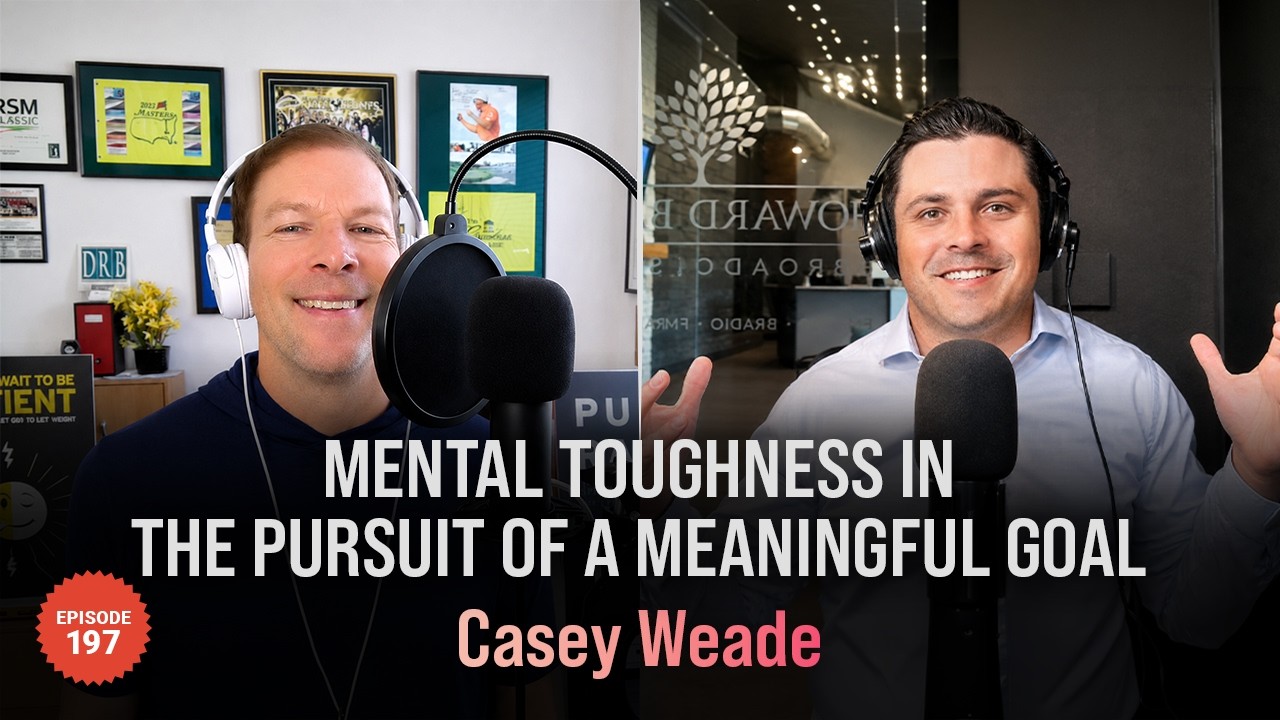
Casey is the CEO of Howard Bailey Financial.
Casey Weade mental toughness is not about blindly enduring pain, grinding through misery, or collecting more money just because we can. It is about pursuing goals that matter deeply enough to justify the obstacles in front of us.
That distinction changes everything. It changes how we handle a bad shot, lead a team, build wealth, prepare for retirement, and decide what comes next after we have reached a goal we once believed would make us happy.
Table of Contents
- 1. ⛳ Treat Every Bad Shot as a Fresh Start
- 2. 🗣️ Communicate Frustration Before It Buries Us
- 3. 🧘 Build Discipline Before the Day Tests Us
- 4. 🎯 Set Goals That Go Beyond Status, Things, and Money
- 5. 👨👩👧👦 Let Family and Faith Reframe What Success Means
- 6. 🧠 Remember What Is True Instead of Chasing the Next Shiny Object
- 7. 🏛️ Build a Culture on Trust and Accountability
- 8. 🌳 Stop Overwatering the Fig Trees That Will Not Produce Fruit
- 9. 🤝 Choose Relationships Over a Purely Transactional Future
- 10. 🏔️ Pursue a Meaningful Goal, Not Pain for Pain’s Sake
1. ⛳ Treat Every Bad Shot as a Fresh Start
Golf is one of the best laboratories for mental toughness because there is nowhere to hide. Every swing tests our focus, emotional regulation, and ability to reset.
Business works the same way. A bad meeting, a missed opportunity, a difficult client conversation, or a hard quarter can knock us sideways if we carry it into the next decision.
One of the most useful lessons in Casey Weade mental toughness is simple: it is okay to get mad, but it is not okay to get down.
Feeling frustration is human. Pretending we do not feel it is usually worse. When we hold anger inside, it can stay with us for 18 holes, 18 months, or 18 years. The real work is letting the emotion move through us without allowing it to become our identity or dictate the next shot.
- Feel the disappointment.
- Communicate it honestly when needed.
- Learn from it.
- Leave it where it happened.
- Commit fully to the next shot.
We do not need perfection to perform well. We need the ability to recover quickly.
2. 🗣️ Communicate Frustration Before It Buries Us
Mental toughness is not silent suffering. It includes the willingness to put difficult things on the table.
Whether we are dealing with a teammate, client, spouse, caddie, or business partner, frustration that goes unspoken has a way of becoming resentment. When that happens, it affects our judgment, energy, and relationships.
Golf teaches us how to support another person, coach through adversity, and help someone regain perspective. Those same lessons carry directly into leadership. We cannot lead people well if we never learn how to have honest conversations with them.
In business, especially under pressure, we need to ask: Are we holding something in because we are trying to avoid a difficult moment? Or are we willing to communicate clearly enough to create a better outcome?
3. 🧘 Build Discipline Before the Day Tests Us
A disciplined routine does not eliminate adversity, but it gives us a better foundation when adversity arrives. In the Casey Weade mental toughness approach, routine is not about looking productive. It is about creating the stability to stay centered when the day gets chaotic.
A strong morning can include meditation, cold exposure, a hard workout, and being fully present with family before the workday begins. The exact routine will differ for each of us, but the larger principle is the same: we need habits that keep us from getting knocked off balance by every problem that shows up.
This also applies to investing. We cannot simply close our eyes, sit on our hands, and hope everything works out. We need disciplined guardrails and rules. When the market falls sharply, we go back to the principles we established before emotions took over.
That is a major takeaway from pressure and performance in wealth management: our ability to perform under stress is usually determined long before the stressful event occurs.
4. 🎯 Set Goals That Go Beyond Status, Things, and Money
For years, many of us set goals around the same things: the car, the house, the family, financial independence, and external markers of success. Those goals are not inherently wrong. The problem is believing that reaching them will automatically bring fulfillment.
At a certain point, we may discover that we have acquired what we thought we wanted and still feel empty. That can be a painful realization, but it can also become a turning point.
Casey Weade mental toughness lessons asks us to go deeper than achievement. What gifts have we been given? Who can we help? What impact can we make with the talents, platform, experience, and resources we have?
Financial independence should not be a finish line where we stop contributing. It should create greater freedom to use our strengths in ways that serve other people.
That is why a meaningful goal needs more than a number attached to it. It needs a reason. It needs a why.
5 Mental Toughness Advantages For Financial Advisors |
|
Download |
| Click here |
5. 👨👩👧👦 Let Family and Faith Reframe What Success Means
Major life challenges have a way of clarifying what matters. A family health crisis can change our perspective on work, money, achievement, and time in an instant.
When life forces us to step away from the pace of business, we may initially believe the answer is simply more time with family, more attention to health, more hobbies, and more rest. Those things matter tremendously. Yet even when we are doing all the right things, we can still feel lost if we have disconnected from our deeper purpose.
Faith can provide a foundation in those moments. It reminds us that our talents are not just for our own advancement. We can lean into faith when obstacles are difficult, when our identity feels uncertain, and when we need the courage to move forward.
We are not here merely to accumulate. We are here to use what we have been given to make a meaningful impact in the lives of others.
6. 🧠 Remember What Is True Instead of Chasing the Next Shiny Object
One of the Casey Weade mental toughness lessons is that growth is often less about learning something brand new and more about remembering something true.
We live in a world that is constantly selling the next tool, tactic, framework, product, and shortcut. But many of the answers we need are things we already know and have simply failed to practice consistently.
That takes humility. It means admitting that we may not need another dramatic reinvention. We may need to return to the principles that helped us before:
- Take care of our health.
- Have the difficult conversation.
- Stay disciplined.
- Lead with integrity.
- Keep pursuing personal growth.
- Use our gifts in service of others.
Coaches, books, podcasts, and mentors can all help us remember what matters. But none of them can do the implementation for us.
7. 🏛️ Build a Culture on Trust and Accountability
Culture is not ping-pong tables, nap rooms, or workplace perks. Culture is how we treat one another, what we tolerate, and what we repeatedly reinforce.
Whether we intentionally shape culture or not, a culture will form. If we avoid hard conversations, overlook recurring behavior, and fail to create accountability, we may eventually build an environment full of drama, conflict, and resentment.
Healthy culture is concrete. It affects retention, attraction, results, and profitability. More importantly, it affects whether people feel valued and whether they can do their best work.
Consistent communication is one way to shape that culture. A transparent weekly message, regular teaching, and repeated reminders of the standards that matter can turn values from wall decorations into daily practice.
This is why mental toughness work for teams matters. A resilient organization does not emerge from motivational speeches alone. It is built through consistent expectations, trust, and accountability.
8. 🌳 Stop Overwatering the Fig Trees That Will Not Produce Fruit
Many leaders struggle with accountability because they care deeply about people. We may keep investing in someone who is not performing because we want to believe they will eventually figure it out.
That is the fig tree problem. We keep watering, pruning, and waiting for fruit even though the tree continues to produce none. At some point, refusing to draw a line is not compassion. It can be avoidance.
We may be protecting ourselves from the discomfort of being judged, admitting a hiring mistake, or confronting someone directly. Meanwhile, the lack of action can harm the entire team, the business, our family, and even the person we are trying to protect.
Accountability does not mean assuming people are lazy or uncaring. It means leading from above the line. We begin with trust, curiosity, and direct conversation instead of inventing a story about why someone is falling short.
We listen. We learn. We clarify expectations. Then we hold people accountable to what has been discussed.
9. 🤝 Choose Relationships Over a Purely Transactional Future
Technology will continue to reshape financial services, business, and nearly every other industry. Automation, AI, digital tools, and consolidation are not going away. We should embrace technology where it improves service, access, and impact.
But technology cannot replace genuine relationships.
The future likely creates two paths. Some organizations will become increasingly technology-driven and transactional. Others will double down on knowing people deeply, having meaningful conversations, and creating experiences rooted in trust.
People do not only need conversations about investments, returns, products, taxes, or risk metrics. They need space to talk about identity, family, purpose, fear, and what they actually want their money to make possible.
That is the heart of Casey Weade mental toughness lessons in financial planning: money should support a life of meaning, not become the sole scorecard for whether we are winning.
For more on that relationship-centered approach, explore why wealth management must remain relationship-first.
10. 🏔️ Pursue a Meaningful Goal, Not Pain for Pain’s Sake
We often define mental toughness as doing difficult things and refusing to quit. There is truth in that. Sometimes we need to push through discomfort to discover what we are capable of.
But there is also danger in glorifying struggle for its own sake.
Imagine someone five years from retirement who hates their job, feels miserable every day, and has already accumulated enough resources to step away. If that person keeps grinding only because the work is hard, that may not be bravery. It may be fear wearing the mask of toughness.
The same question applies to every goal: Why are we still pursuing this? Is the target meaningful enough to justify the cost?
Real mental toughness can mean continuing through pain when the mission is meaningful. It can also mean stepping away from a race that no longer serves our purpose and choosing a different mountain to climb.
Retirement illustrates this perfectly. Some people thrive with travel, golf, family time, and a slower pace. Others lose their identity because their work was also their primary way of serving others. When that happens, we need to intentionally recreate a new outlet for contribution.
Use a Joy Lifeline to Design What Comes Next
A useful exercise is to create a personal lifeline. Starting from childhood and moving to the present, plot periods of joy and sorrow on a scale from zero to ten. Then look for patterns.
What experiences consistently brought joy? Was it competition, family, helping others, teaching, building, creating, faith, or service? What consistently produced stress, angst, or emptiness?
Retirement and financial freedom give us the opportunity to bring more of the joyful, meaningful elements forward while reducing what no longer belongs in our lives.
There is no final finish line. There is always another chance to grow, serve, learn, lead, and make a difference. That is the real message of Casey Weade mental toughness lessons pursue something meaningful enough that the hard moments have a purpose.

Dr. Rob Bell is a Sport Psychology Coach. DRB & associates coach executives and professional athletes. Some clients have included three different winners on the PGA Tour, Indy Eleven, University of Notre Dame, Marriott, and Walgreens.
- Check Out All The Books
- Keynote Speaking On Mental Toughness
- Mental Toughness Podcast as we interview expert athletes and coaches about Mental Strength and their Hinge Moment.
- New Blog Posts are published weekly.
- Follow on Twitter @drrobbell
- Follow on Instagram @drrobbell