Mental toughness in wealth management is easy to talk about when markets are calm, plans are clean, and life is predictable. It gets real when uncertainty shows up, when leadership gets tested, and when emotions start driving decisions.
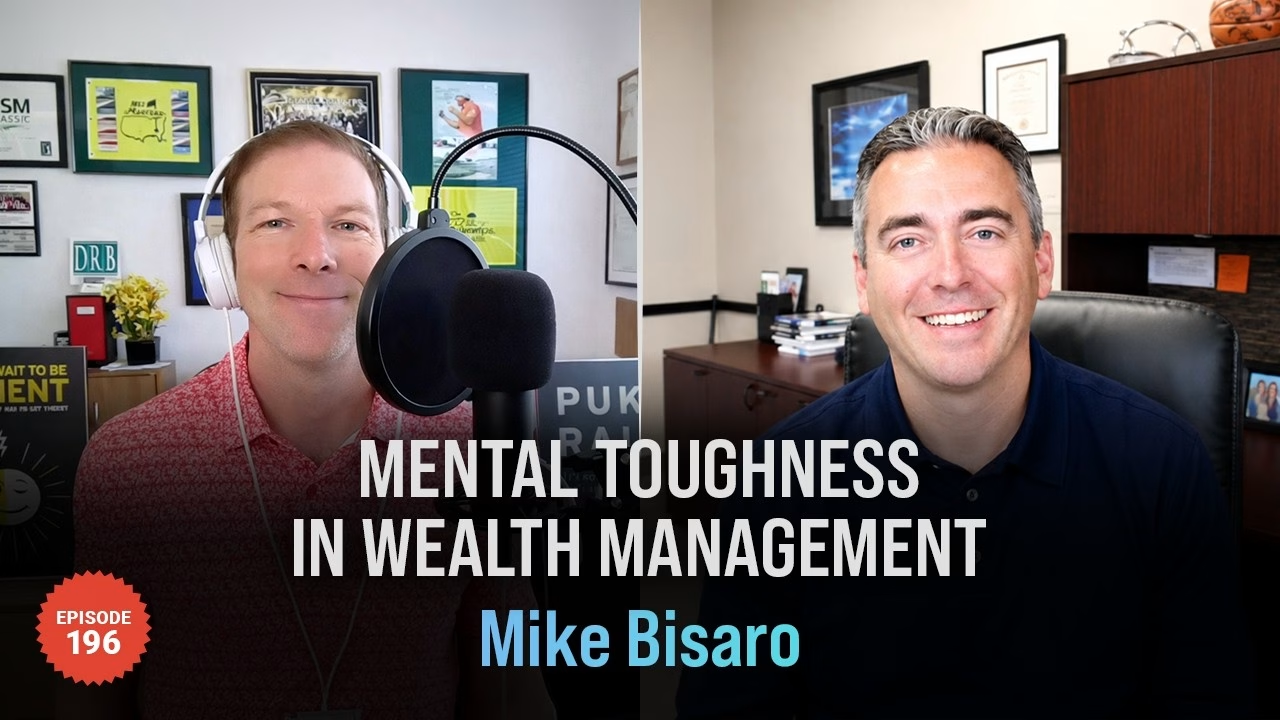
Mike Bisaro was awesome guest on mental toughness podcast as we discussed hinge moments and mental toughness in wealth management.
What stood out most is that this business is not really about numbers first. It is about people first. The spreadsheets matter. The planning matters. The investment process matters. But if you miss the human side, you miss the whole game.
Mental toughness in wealth management shows up in how you handle risk, how you lead through disruption, how you communicate under pressure, and how you help people make good long term decisions when their brains are begging for short term relief.
Table of Contents
- ⛳ Golf Was Never Just Golf
- 🏌️ What Great Caddies Teach You About Advisory Work
- 🧭 The Hinge Moment of Buying a Firm in 2020
- 📉 Risk Is Usually About Loss, Not Theory
- 👥 Building a Team That Complements, Not Clones
- 🧠 The Easiest Financial Decision Is the Hardest Mental Decision
- 🪞Retirement Is More Psychological Than Most People Expect
- 💬 Wealth Transfer Is a Communication Challenge First
- 📞 This Is a Pure Communication Game
- 🤖 AI Should Free You Up to Be More Human
- 🚀 The Future of Wealth Management Still Belongs to Relationships
- 📚 Keep Learning, Keep Growing, Stay Grateful
⛳ Golf Was Never Just Golf
If you want to understand why relationship skills matter so much in mental toughness in wealth management, start with golf.
Golf can quietly train you for advisory work in ways that are easy to miss at first. It puts you around people who are older, more experienced, and often very different from you. It teaches you how to be comfortable in conversation, how to observe, and how to build rapport without forcing it.
That matters. A lot.
One of the great lessons here is that many people come into finance assuming the job is about being the smartest person in the room about money. It is not. Early in Mike’s career, a mentor cut straight through that idea. The business was really about building and maintaining relationships and being comfortable speaking with people, especially people older than you.
That is a major principle of mental toughness in wealth management. You do not need to posture. You do not need to pretend. You need to connect.
Curiosity helps too.
If you genuinely like people, ask good questions, and care about their stories, you already have part of the foundation. That is one reason the profession is often a better fit for people who enjoy conversation and human complexity more than sitting in front of a spreadsheet all day.
🏌️ What Great Caddies Teach You About Advisory Work
There is a reason caddies make such strong hires.
Caddies learn discipline, awareness, humility, and communication. They are around pressure all the time. They learn how to support someone else’s performance without needing the spotlight. In many ways, that is a terrific model for an advisor.
The Evans Scholar path is a great example. It is demanding, selective, and not something you can bluff your way through. That matters because it signals character. It signals work ethic. It signals the ability to handle responsibility before you are handed a title.
In mental toughness in wealth management, those traits carry over beautifully:
- Preparation before performance
- Comfort with people from many backgrounds
- Steadiness under pressure
- Service orientation instead of ego
- Trust earned slowly through consistency
A caddie is not there just to give yardages. A great advisor is not there just to give numbers. Both roles involve guidance, perspective, calm, and timing.
🧭 The Hinge Moment of Buying a Firm in 2020
Some hinge moments announce themselves. Others hit you all at once.
Taking ownership of a firm after years of succession planning should have felt like a clean launch. Instead, it collided almost immediately with the chaos of early 2020. Signed paperwork was barely back, and then the world changed. Markets dropped hard. People were isolated. The future felt foggy.
That is where mental toughness in wealth management stops being theory.
There were plenty of reasons to second guess the timing. Plenty of reasons to ask whether the move had been made at the worst possible moment. But once you are all in, there is something clarifying about it. Your options narrow. Forward becomes the only real direction.
That pressure created several lessons:
- You do not always get to lead on your ideal timeline.
- Patience can be more valuable than speed.
- Communication becomes oxygen during uncertainty.
- Many things you thought needed immediate change can wait until you understand more.
That last point is important. Under pressure, leaders often want to prove leadership by changing everything. But disruption itself can become a teacher. In this case, slowing down revealed that some early assumptions would have led to rework later anyway.
If this topic resonates, you might also appreciate this piece on financial advisor leadership, process, and resilience.
5 Mental Toughness Advantages For Financial Advisors |
|
Download |
| Click here |
📉 Risk Is Usually About Loss, Not Theory
One of the more honest observations in this conversation is that when people say risk tolerance, they often really mean loss tolerance.
That is not just semantics. It gets to the core of mental toughness in wealth management.
No one complains about volatility when their account is rising. The word becomes popular when prices are falling and fear is rising. That is when emotions get loud. That is when long term plans feel suddenly negotiable.
Experience helps here. Going through downturns changes you. It gives you perspective. It does not make uncertainty disappear, but it does make you less likely to overreact to every headline.
That kind of seasoning matters for advisors and for clients. It is one reason pressure and performance in wealth management deserves more attention than it usually gets. Pressure does not create character as much as it reveals whether your process is strong enough to hold when emotions rise.
Mental toughness in wealth management does not mean ignoring downside. It means seeing it clearly without letting it dictate every move.
👥 Building a Team That Complements, Not Clones
Leadership gets harder when your job shifts from doing the work to building the environment where good work happens.
That transition from advisor to leader is not automatic. It is a separate skill. And one of the biggest mistakes leaders make is hiring people who look and think too much like themselves.
Resilient teams are built through complementary strengths.
Some people are wired for details, controls, and clean numbers. Others are wired for direct conversation, education, and strategic thinking. You need both. You also need the humility to bring in people who know more than you do in certain areas.
That is not a threat to leadership. That is leadership.
One line that came up was terrific: hiring is the best compliance. That is exactly right. You solve many future problems before they happen by being disciplined at the front end.
Mental toughness in wealth management is not just about how you perform personally. It is also about whether you can create a team that stays resourceful, adaptable, and stable under pressure.
🧠 The Easiest Financial Decision Is the Hardest Mental Decision
This may be the cleanest summary of the entire profession: the easiest thing to do financially is often the hardest thing to do mentally.
Why?
Because your brain loves comfort, certainty, and recent evidence. If something has gone up for a long time, buying feels easy. If something has gone down for a long time, selling feels easy. Emotionally, both moves feel justified.
Financially, they are often backward.
You can teach this with charts. You can explain it in classrooms. You can nod along when someone else says it. But when fear is active in real time, the lesson changes shape. That is when mental toughness in wealth management matters most.
Much of the advisor’s role is helping prevent emotional decisions. Not through force. Not through arrogance. Through guidance and perspective is how mental toughness in wealth management gets built.
That is why this work often blends teacher, coach, and steady hand. If you are helping someone understand what is happening, what they are feeling, and what decision actually aligns with their long term goals, you are doing the deepest kind of advisory work.
For more on this dynamic, this article on why dropping from the stock market feels like this connects directly to the emotional reality behind those decisions.
🪞Retirement Is More Psychological Than Most People Expect
Traditional retirement planning spends a lot of time on numbers, target dates, and income replacement. But one of the biggest blind spots is psychological readiness.
You cannot just retire from something. You have to retire to something.
That line is worth sitting with.
For many people, work provides more than a paycheck. It gives routine, identity, purpose, structure, challenge, and social connection. Remove all of that at once and even a financially sound retirement can feel disorienting.
That is why the people who obsess over the exact exit date can be the most concerning. When someone counts down retirement in years, months, days, hours, and minutes, it can signal that they are only focused on escape. They are staring at the finish line without asking what comes after it.
The better question is simple: what happens the next day?
Mental toughness in wealth management becomes incredibly relevant here because this is not a math problem alone. It is an identity transition. It is often a purpose transition. Some people are prepared for that. Many are not.
That is why “preferment” is such an interesting way to think about it. Not the end. A transition. A move toward something meaningful.
💬 Wealth Transfer Is a Communication Challenge First
The great wealth transfer gets discussed in giant numbers, but the real action happens inside families.
And inside families, the biggest issues are usually not spreadsheets. They are communication gaps.
People inherit assets they do not understand. They do not know the tax implications. They do not know the structure. They do not know the intentions behind the planning. In some cases, there were smart strategies available years earlier that never happened because the necessary conversations never happened.
That creates avoidable friction, confusion, and sometimes major family conflict.
Mental toughness in wealth management shows up here as the willingness to have honest conversations before they become urgent. It takes courage to talk about money clearly. It takes maturity to explain plans, expectations, and responsibilities. It takes discipline to stop avoiding the uncomfortable discussion.
Simple planning steps can go a long way:
- Basic estate documents in place
- Clear explanation of intentions
- Education for heirs before transfer happens
- A trusted guide to walk the family through decisions
When communication improves, outcomes usually improve with it.
📞 This Is a Pure Communication Game
If you strip the profession down to its core, wealth management is a communication business.
Not because math is unimportant. But because the math is rarely the hardest part.
The real work is listening well enough to understand what is actually driving a person’s choices. Fear, confusion, identity, habits, old beliefs, family dynamics, pride, shame, urgency, uncertainty. That is the stuff under the question.
And if you answer only the surface question, you often miss the real need.
That is why a quick email answer is not always enough. Sometimes the right response is, this is a great question, let’s talk. Because there are layers underneath it that need to be uncovered before the answer will really land.
Mental toughness in wealth management depends on your ability to slow down and communicate at depth. Not just faster. Better.
🤖 AI Should Free You Up to Be More Human
Technology is exploding across the advisory world. AI tools are everywhere. New systems, new workflows, new promises, new pressure.
That can create a kind of arms race mentality.
- Are you behind?
- Are you missing the next thing?
- Are you moving fast enough?
The healthiest response is the same one you would give a client in a noisy market: calm down.
Not every tool deserves adoption. Not every innovation improves service. And not every fear signal is trustworthy, especially when the person selling the fear is also selling the solution.
That is a fantastic filter.
The real opportunity with AI and new tools is not to replace the human side. It is to remove friction so you can spend more time doing the least technological and most valuable part of the work, which is talking to people.
That is a powerful insight for mental toughness in wealth management. The future does not belong to the coldest system. It belongs to firms that combine useful tools with real human connection.
🚀 The Future of Wealth Management Still Belongs to Relationships
The future is likely more comprehensive, more tech enabled, and more education driven. But it still comes back to trust.
There is a growing need for end to end support that meets people where they are. For some, that starts with saving, spending, budgeting, or debt questions. For others, it becomes planning, investment management, retirement transition, or family wealth decisions.
The best model is not all technology and not all handholding. It is both. Scalable tools plus human access. Education plus guidance. Efficiency plus empathy.
The industry also needs new talent. Younger talent. More diverse talent. More people who understand that mental toughness in wealth management is not about sounding impressive. It is about being steady, teachable, and genuinely useful.
📚 Keep Learning, Keep Growing, Stay Grateful
Continuous growth came up again and again. Reading more. Thinking better. Getting coached. Taking physical health more seriously. Rebuilding routines that support sharper thinking and stronger energy.
That matters because mental toughness in wealth management is not compartmentalized. Your physical habits affect your clarity. Your clarity affects your leadership. Your leadership affects your team. Your team affects the client experience.
It all connects.
And maybe the best closing note is gratitude. Not every hinge moment is tragedy. Some are opportunities wrapped in pressure. That perspective matters. It keeps you grounded. It reminds you that leadership and growth are privileges, not just burdens.
Mental toughness in wealth management is not loud. Most of the time it looks like composure, thoughtful communication, disciplined choices, humility, and a refusal to let short term emotion hijack long term purpose.
That is the work. And when you do it well, you are not just managing money better. You are helping people live better.

Dr. Rob Bell is a Sport Psychology Coach. DRB & associates coach executives and professional athletes. Some clients have included three different winners on the PGA Tour, Indy Eleven, University of Notre Dame, Marriott, and Walgreens.
- Check Out All The Books
- Keynote Speaking On Mental Toughness
- Mental Toughness Podcast as we interview expert athletes and coaches about Mental Strength and their Hinge Moment.
- New Blog Posts are published weekly.
- Follow on Twitter @drrobbell
- Follow on Instagram @drrobbell