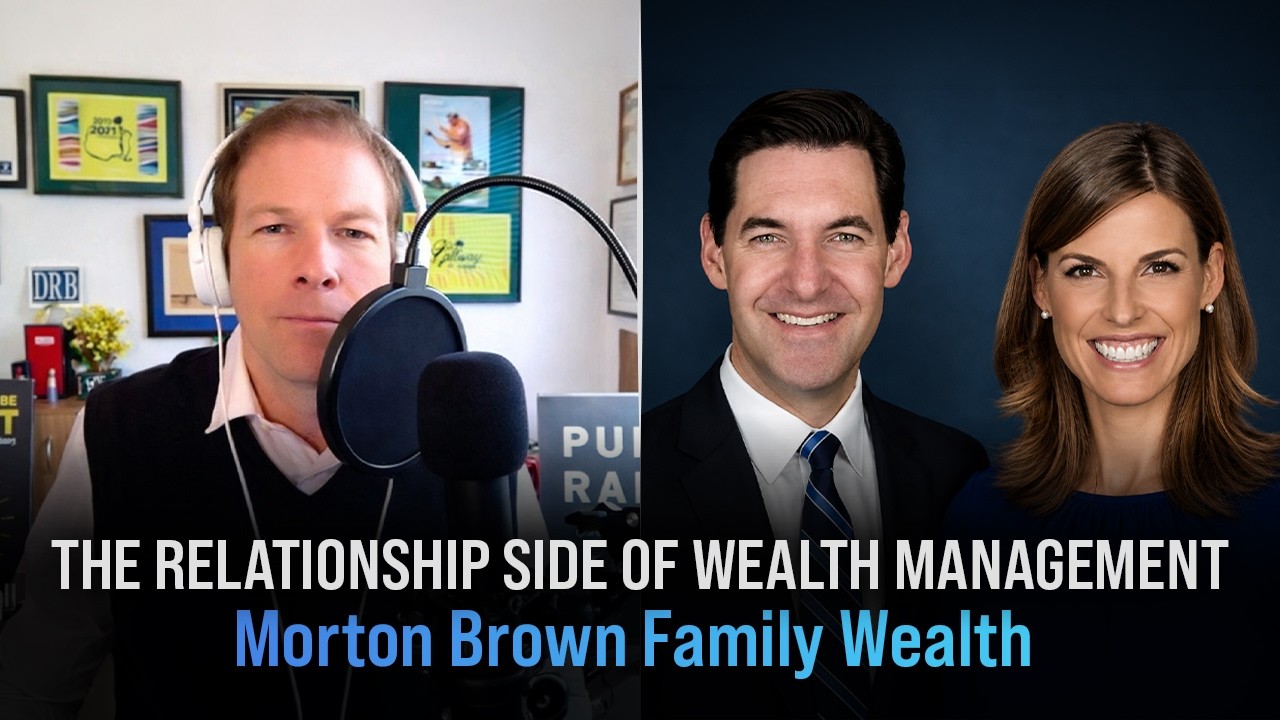
When we talk about the relationship side of wealth management, we are really talking about something much bigger than portfolios, performance reports, or account balances. We are talking about how money supports a life, how families make decisions together, how trust gets built over time, and how advisors can either reduce anxiety or quietly create more of it.
Dennis Morton and Katie Brown have built their firm around that belief. Their work shows what happens when a business is designed with intention, when culture is treated like strategy, and when the human side of finance is given the same attention as the technical side. What follows is a conversation about vision, ownership, leadership, fear, and the relationship side of wealth management in its fullest sense.
Table of Contents
- 🎯 Building with intention
- 📈 The billion dollar goal and what sat underneath it
- 🧭 Vision, transparency, and the culture of ownership
- 🛠️ Consistency and the discipline behind trust
- 💬 What wealth is actually for
- 🔍 Where the industry needs to get better
- 🪜 Succession as a leadership responsibility
- ❤️ Personal hinge moments that shaped the work
- 🔥 Fear, courage, and starting from zero
🎯 Building with intention
How did you decide to build a firm together instead of following a more traditional succession path?
We spent about a decade working in the same firm before Morton Brown Family Wealth ever existed. For a long stretch, our roles were different enough that we did not overlap much. What changed things was getting outside perspective and beginning to ask harder questions about mission, long term direction, and what we wanted our work to look like ten years down the road.
As those conversations deepened, it became obvious that we were much more aligned with each other than with the direction of the firm we were in. We both felt the tension of knowing what we did not want. We did not want misalignment around values. We did not want a lack of transparency. We did not want to drift into the future and realize we had built something by default instead of by design.
That was the turning point. We started asking a simple but demanding question: if we could build this from scratch, what would it look like? Once we began answering that honestly, the path became clearer.
What gave you confidence that the partnership would work?
Part of it was complementarity. We both came to financial advice from different angles, and that mattered. On paper, lots of people in this industry carry the same title. In practice, they can think and lead very differently. We felt our strengths rounded each other out well.
The bigger factor, though, was that we were willing to do the softer work up front. That is usually the work people skip. We sat down and got very honest about where we were personally, professionally, and what kind of lives we were actually trying to build. Those conversations were not abstract exercises. They were deeply practical.
We asked each other things like:
- What does an ideal day look like?
- What values are non negotiable?
- What kind of leadership do we want to practice?
- What are we unwilling to sacrifice to build a business?
That groundwork helped us create a firm that reflected who we were, not just what the market expected.
📈 The billion dollar goal and what sat underneath it
You set a very ambitious long term target. What was the point of having such a big goal?
A couple of years into the business, after we had found our footing, we asked whether we needed a bold target out on the horizon. At the time, we were managing a little over $100 million. So we asked what it would take to grow tenfold in ten years and become a billion dollar firm.
That question led to a detailed model. We mapped out assets, revenue, headcount, number of clients, and the operating milestones needed year by year. The value of that process was not only the number at the end. It was the discipline required to reverse engineer the future.
That kind of intentionality matters in the relationship side of wealth management because growth can become hollow very quickly if it is only about scale. If all you have is a bigger number, but the experience gets worse, the mission gets diluted, and the people inside the firm are exhausted, then the growth is not really success.
So the goal was not just financial?
Exactly. The quantitative side was only half of it. We wanted the qualitative side to be just as clear. We kept coming back to the same idea we often share with clients: the number is not the point. The number supports the experience you are trying to create.
So we asked ourselves what kind of client experience we wanted, what kind of employee experience we wanted, and what kind of presence we wanted in our community. We wanted the business to support a good life, not consume one.
That led us to build in mini sabbaticals for every employee every five years. Five weeks completely off. Fully unplugged. That was not only a gift to the team. It was also a stress test for the business. It forced us to close process gaps, reduce single points of failure, and make sure clients knew the broader team instead of relying on one person.
That is one of the clearest examples of the relationship side of wealth management internally. If we want clients to live intentionally, we should lead that way ourselves.
Did that level of planning actually translate into results?
It did. At one of our quarterly offsites, around the midpoint of the plan, we pulled up the original spreadsheet and saw that many of the numbers were almost exactly on track. Assets, staffing, and milestones were landing very close to what we had modeled. Shortly after that, we crossed the $500 million mark and celebrated it.
What made that meaningful was not simply hitting the number. It was seeing that intentional planning, when paired with consistent execution, can compound over time. That same discipline is something many advisors try to create for clients but do not always practice in their own firms.
🧭 Vision, transparency, and the culture of ownership
What does transparency look like inside your firm?
It starts with overcommunication. We say that with affection. We would rather have too much healthy communication than too little. We hold regular staff meetings, quarterly offsites, and many smaller conversations in between. We want ideas moving across roles, not getting trapped inside silos.
One of the most helpful cultural choices we made was refusing to shut down office chatter just because it sounds noisy. Productive chatter is where collaboration lives. It is where people begin to understand what everyone else does. It is where improvements to process often start.
That has been foundational to how our workflows have improved and why our team can keep strengthening the client experience. In the relationship side of wealth management, communication is not a side activity. It is the operating system.
How do you create ownership instead of just asking for buy in?
Ownership shows up when people feel trusted, understood, and empowered to act. We have seen that in very concrete ways. A great example came when two newer team members needed to be onboarded during an especially busy season. Two employees had already been meeting on their own to build a training program before we even asked. They saw what needed to happen, built a plan, and came to us with it.
That is ownership. Not waiting to be told. Not needing every step approved. Seeing the need, caring about the team, and stepping in.
We have also used assessments like Kolbe and DISC over the years. Not as labels, but as a way of signaling to people from the beginning that we care about how they work best. We are not trying to squeeze everyone into the same mold. We want people to know their strengths, understand each other, and do their best work.
If leadership wants a stronger culture, it helps to stop acting like all growth must run through the founders. We have found a lot of value in becoming more dispensable over time. That is leadership, not ego.
That same idea connects naturally with leadership and culture in wealth management. When people feel ownership, retention, service, and trust all get stronger together.
🛠️ Consistency and the discipline behind trust
You have said consistency matters a lot. Why?
Because trust is built through repeated experience. Clients should know who is showing up for them. Teammates should know who is showing up for them. The most impressive strategy in the world loses value if the experience around it feels erratic.
Each year, we choose a few words that shape how we want to lead and operate. Consistency has been one of those words. That means asking whether our workflows support a repeatable client experience. It means checking whether our communication is regular enough. It means making sure our presence in the community and with one another is not occasional or performative.
The relationship side of wealth management depends on that steadiness. People do not just need expertise. They need reliability. They need clarity. They need to feel that someone is present, not merely available.
There is a strong overlap here with mental toughness. Advisors who want to serve at a high level can benefit from ideas like the ones explored in these principles of mental toughness for financial advisors, especially around focus, composure, and showing up the same way under pressure.
💬 What wealth is actually for
What do many advisors miss about the relationship side of wealth management?
Too often, the conversation gets stuck at performance. Returns matter, of course. Planning matters. Technical expertise matters. But none of those should crowd out the deeper question: what is this money here to do?
One of the most meaningful moments we have experienced came with a long time client who had spent years very focused on investment results. Market dips created anxiety. Strong periods created excitement. The meetings often gravitated right back to the portfolio.
Then one day, after talking with his adult sons about their own financial future, he realized something important. They were going to be okay. That opened an entirely new conversation. Instead of obsessing over whether every dollar could do a little more, he was ready to ask how his resources could support a richer life as he and his wife moved into their next chapter.
5 Mental Toughness Advantages For Financial Advisors |
|
Download |
| Click here |
That was the real conversation. Not just preserving wealth, but using it with confidence and joy.
We think of this as helping families connect their financial resources to a life of contentment. That is the heart of the relationship side of wealth management. Money should support relationships and meaningful experiences, not quietly work against them.
Why do people need permission to spend money they already have?
Because many people have spent decades accumulating and being careful. They become very good at saving and not nearly as comfortable at using money for the very things they say matter most.
So when someone calls and says they want to take a distribution for a family trip or a meaningful experience but feel guilty doing it, we see that as a chance to celebrate with them. That enthusiasm surprises some people. It can feel almost backward in a business that is often measured by what stays invested.
But if a family has done the work and the plan supports it, then helping them fund deeper relationships is not a side benefit. It is the purpose. That is why the relationship side of wealth management has to stay front and center.
🔍 Where the industry needs to get better
What are the biggest weaknesses you see in the broader advisory industry?
There are several forces converging at once. Succession issues are becoming more urgent. Private equity is influencing ownership and decision making. Technology options are expanding at a breathtaking pace. And there is a growing shortage of advisors coming into the profession.
Those pressures can push firms inward. They can become preoccupied with their own structural problems and lose sight of client confidence. That is risky, especially when families increasingly want more holistic guidance.
We think clients should expect more than they often do now. Many households arrive without a real financial plan. They may have statements and scattered accounts, but not an integrated way of thinking about major decisions. Retirement income, Roth conversions, Social Security timing, family legacy, tax moves, charitable intentions, all of those questions are often left sitting on the client’s shoulders.
That is where the relationship side of wealth management matters again. People do not just need investment management. They need a place to bring the whole picture.
What do advisors get wrong in client communication?
Sometimes the industry hides behind complexity. Statements are hard to understand. Meetings are heavy with jargon. The advisor becomes the only one who supposedly knows what is happening. That can create dependence, but not confidence.
We push in the opposite direction. We think simplicity and clarity are worth fighting for. We want both spouses to understand what is going on, not only the one who asks the most questions. We want clients to come to us first, before spending hours trying to decode a planning topic on their own.
Education is part of the work. If people do not understand what they own, why they own it, and how the pieces fit together, anxiety tends to rise. And if anxiety rises, decision making suffers.
That is one reason we think clarity is a competitive advantage in the relationship side of wealth management.
There is also a fear component to this. Many hard conversations are avoided because people do not want to feel exposed or uncertain. That is true for advisors and clients alike. The psychology behind facing those moments is similar to what is discussed in practical ways to dominate fear.
🪜 Succession as a leadership responsibility
You have said succession is not a future problem. What do you mean?
We think succession is a present leadership obligation. Dennis’s military experience shaped a lot of that thinking. In that world, leadership roles are temporary by design. You know someone else will take the chair after you, so part of your job is preparing the organization for that reality.
Business owners often avoid that mindset. They assume they can deal with succession later. But later has a way of arriving with bad timing. We have seen too many cases where leadership did not prepare the firm, and people around them paid the price.
For us, succession starts with building a business that does not rely on one heroic person. If one founder goes on sabbatical, the firm should still run well. If a leader is unavailable, decisions should not pile up helplessly. That is not just good process. It is respect for clients and for the team.
The relationship side of wealth management is weakened when firms are built around personality instead of continuity.
❤️ Personal hinge moments that shaped the work
How have personal hardships changed the way you lead and serve?
Dennis’s life and work were profoundly shaped by the loss of his infant son, Teddy, who was born with a rare leukemia and required immediate treatment far from home. For months, the family lived between hospitals and temporary housing while trying to care for both Teddy and their older child. Teddy died at four months old.
Experiences like that reorder everything. One of the enduring lessons was how painful it was not to have pediatric care close to home. Years later, when the opportunity emerged to support a children’s hospital in the Lehigh Valley, Dennis and his wife stepped into that effort. What had once been a source of deep grief became a source of service to other families.
That kind of experience sharpens the relationship side of wealth management because it strips away pretense. You come back with a clearer sense of what matters, how community works, and why work should connect to something larger than income.
Katie, how did your cancer diagnosis affect your perspective?
Katie was preparing for the Boston Marathon, helping plan the launch of the firm, and raising young children when she was unexpectedly diagnosed with breast cancer in her thirties. There was no obvious family history and no expectation that such news was coming.
What stands out is how she responded. She treated the race, the business launch, and family life as healthy anchors during a difficult season. There were surgeries and fear and uncertainty, but there was also movement. In a remarkably compressed stretch, she finished treatment, ran Boston in brutal conditions, and helped launch the firm.
Moments like that deepen your belief that numbers on a page are never the whole story. Relationships, support, and purpose become even more central. They also create a culture where asking someone, “How are you doing, really?” is not small talk. It is part of how people care for one another.
🔥 Fear, courage, and starting from zero
What role has fear played in building your business?
Fear is part of every meaningful step. When we launched the firm, there was a day we still celebrate each year, the day we sat in a tiny office with a list of names and no real business yet. All we could do was pick up the phone and begin calling clients, inviting them into what we were building.
That is what staring at zero feels like. It is equal parts thrilling and terrifying. You are asking people to trust your vision before it has much visible proof behind it.
But that moment also taught us something important. Courage grows in community. We were not doing it alone. And over time, we have tried to build a culture where people can speak up, make mistakes, and recover without shame.
If fear of failure dominates the environment, people play small. If mistakes can be owned and learned from, people get bolder in healthy ways. That has become part of our culture and part of how we practice the relationship side of wealth management.
What does all of this add up to for you now?
It adds up to a simple but demanding belief: money should serve life, and firms should be built the same way. That means designing with intention, communicating openly, empowering people, simplifying complexity, and helping families use wealth to deepen relationships instead of simply enlarging accounts.
The relationship side of wealth management is not a soft extra. It is the work. It is the place where planning becomes meaningful, where leadership becomes visible, and where trust becomes durable.
When that is done well, growth follows. But growth is the byproduct, not the mission.

Dr. Rob Bell is a Sport Psychology Coach. DRB & associates coach executives and professional athletes. Some clients have included three different winners on the PGA Tour, Indy Eleven, University of Notre Dame, Marriott, and Walgreens.
- Check Out All The Books
- Keynote Speaking On Mental Toughness
- Mental Toughness Podcast as we interview expert athletes and coaches about Mental Strength and their Hinge Moment.
- New Blog Posts are published weekly.
- Follow on Twitter @drrobbell
- Follow on Instagram @drrobbell